The words environmental injustice and social injustice are often thrown around when referring to what happened in Flint. Environmental injustice is defined as the subjection of certain communities or groups to higher levels of environmental risk than other segments of society. This being said because the poor and marginalized groups were more affected by the water crises. Children in low income and poor communities were getting sick as a result of consuming the contaminated water. However, not much attention was brought to the issue at hand until the push by social media activists.
The situation in Flint Michigan lends a blueprint to not only the mismanagement of water funds but also provides the solution to countries with similar problems and aids in the provision of sustainable resource planing to prevent other such occurrences. Like with any problem resolution, there is a three step process to solving the Flint Water crisis. A temporary solution, an alternate solution and a permanent solution.
Temporary solutions

One of the strategies used to supply people with adequate drinkable water was the handing out bottled water. This, however, is not a feasible solution as research has shown that the average person in the United States consumes about 390 liters of water per day. Now, bottled water is safe for consumption but not adequate enough for other daily household needs. 390 liters accounts for 812 standard bottles of water. This is neither economically nor environmentally friendly and would add to more plastic pollution and thus cannot be a viable long term solution for the future. However, it provides a quick solution to giving the communities healthy drinking water. Another potential solution was water donations. People would donate funds or water tankers to ensure that the communities were receiving healthy drinking water and water to perform basic tasks.
Alternative solution
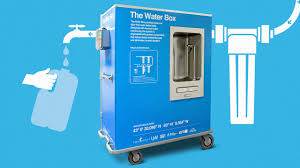
Water filtration systems seem to have been the best way to resolve the water problem. There are two parts to most filtration systems, the chemical filtration and physical filtration. The physical filtration systems filter out the large particles from the water while the chemical filtration systems removes impurities from the water. This is by far one of the most viable solutions as filtration systems can be applied to taps to clean the drinking water and are more economic than the continuous acquisition of water bottles. Such systems were made available for the people of Flint by celebrities such as Jaden Smith. There are however different types of filtration systems. These being reverse osmosis filters, ion-exchange filters, stem distillation filters and activated carbon filters.
Reverse osmosis filters utilize the water pressure of the tap water to remove contaminants such as lead and mercury through a semi-permeable membrane, allowing for water to pass through while the contaminants are filtered out. However, this process is unable to filter out some pesticides and solvents. While ion-exchange filters, on the other hand, soften hard water making for more pleasant tasting water. Stem distillation filters consist of the heating and cooling of water to remove contaminants and activated carbon filters make use of charcoal filters to trap contaminants and, are the most used household filters.
There are 3 types of household filtration systems, under- sink water filters, which clean the immediate water connected to the sink. Counter top water filters, which are mostly used for drinking water and whole house water filters. These regulate all the household water.

Permanent solutions
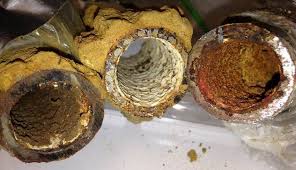
For Flint, the long term goal is to be able to sustainably provide healthy drinking water for its residents. This can be achieved through the detoxification of the Flint River and the Flint Water Plant system. After the detoxification of the water bodies, new pipes should be laid into the system. Ones that would not lead to the contamination of the water as they age. Such proposed pipes are plastic pipe lines. These do not leak toxins and would not harm the water or its inhabitants. Although a short term fix would be to revert back to the Detroit water plant as the main water provider until such a time that the Flint water crisis is resolved. However, all of these solutions should come combined with a change in policies to prevent further such disasters and ensure that should another contamination situation occur, there are policies in place to properly and sustainably ensure that the livelihoods and health of residents is prioritized.
The water crisis is far from over and will take quite some time to properly manage and get rid of. In the time being however, one has to wonder what is being done to prevent other cases.
http://www.sfu.ca/~delicial/Final/Solutions/solutions.html#flint
https://www.nrdc.org/stories/flint-water-crisis-everything-you-need-know
https://www.liebertpub.com/doi/abs/10.1089/env.2016.0011
https://repository.lib.ncsu.edu/bitstream/handle/1840.20/34744/etd.pdf?sequence=1
https://www.ncbi.nlm.nih.gov/pmc/articles/PMC5353852/
https://www.sciencedirect.com/science/article/pii/S0013935117303717
 Water Mania
Leave a comment