The protection and purification of the earth’s air supply is known as air conservation. Transportation, power plants, and factories are just a few examples of sources that pollute the air. Because this pollution can lead to a variety of health issues, it is critical to conserve air whenever feasible. This can be accomplished through lowering emissions from both personal and commercial activity. ~ B Koch
Tweet

Air, while air is largely made up of gas, it also contains a large number of microscopic particles. Aerosols are tiny particles that float around in the air. When the wind blows, some aerosols, such as dust and pollen, are naturally swept up. However, soot, smoke, and other particles from car exhaust and power plants can be carried through the air. These are significant polluters of the atmosphere.
Air pollution can be caused by a variety of factors. Cars and other types of transportation emit a significant amount of pollution into the atmosphere. Manufacturing industries and power plants may also be significant contributors of air pollution, however, the quantity of pollution varies depending on the factory and type of emission activity such as the burning of fossil fuels in factories, methane emissions, CFC’c etc.

Air pollution and biodiversity
The effects of air pollution on biota and the subsequent repercussions on biodiversity are not well understood; only a limited amount of data is accessible.
Air pollution may impact biodiversity if it:
(1) alters genetic diversity within populations
(2) reduces the reproductive potential of biota
(3) reduces crop or natural vegetation production
(4) impairs the structure and function of ecosystems.

Catastrophic natural disasters such as wildfires are becoming more common as a result of climate change. Which has an impact on both atmospheric processes and emissions. Evaporative emissions of anthropogenic volatile organic compounds, as well as biogenic volatile organic compounds and ammonia, will increase as air temperatures rise. Furthermore, methane emissions from wetlands, permafrost habitats, and other key ecosystems are anticipated to be very vulnerable to climate change.
Therefore, climate change and air quality are intricately related. Not only do some air pollutants, such as ozone (O3) and particulate matter (PM), including black carbon, have a direct impact on radiative forcing and hence climate change, but a changing climate can also have an impact on air quality. Furthermore, because emissions sources are so similar, mitigation approaches will almost certainly have an impact on both air quality and climate change. Fossil fuel combustion, for example, releases both the greenhouse gas carbon dioxide (CO2) and air pollutants such as nitrogen oxides, sulfur dioxide, mercury, and particulate matter, whether for energy, transportation, or other purposes.
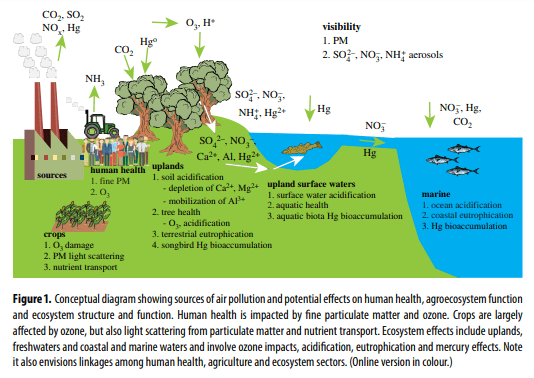
Air pollution contains a variety of chemicals (such as ozone, sulfur, nitrogen, and mercury) that can acidify, eutrophize, and/or exacerbate the hazardous conditions of ecosystems through direct and indirect impacts.
Acidity, nitrogen, and mercury have all been shown to have negative impacts on species and biogeochemical processes in aquatic environments. Acidification of lakes, eutrophication of estuaries and coastal waterways, and mercury bioaccumulation in aquatic food webs are all caused or exacerbated by air pollution. The impacts of air pollution on biogeochemical cycling are extensively established in terrestrial ecosystems, but the consequences on most species and how air pollution interacts with other stressors are less well known. Nonetheless, considerable evidence exists for nitrogen deposition’s impacts on plants in grasslands, alpine environments, and bogs, as well as nitrogen’s effects on forest mycorrhizae.
Ozone has been shown to reduce photosynthesis in a variety of terrestrial plant species. At exposure levels prevalent in the eastern United States, the impacts of these contaminants are mostly chronic, not acute. Only at artificially escalated exposure levels or in conjunction with other conditions like as drought, cold, or infections is mortality frequently found. The acid/aluminum impacts on aquatic creatures, which may be fatal at the acidity levels seen in many surface waters in the region, are significant exceptions. Even if the impacts are typically minor, they are critical for biological conservation.
The changes in species composition produced by acidification or eutrophication on land or in water can spread throughout food webs, affecting creatures other than those immediately affected by pollution. Sublethal concentrations of hazardous pollutants, on the other hand, may diminish reproductive success or render organisms more vulnerable to potentially lethal infections.
Therefore, climate change’s influence on ecosystem structure and function can either alleviate or worsen the consequences of air pollution. Ecosystems’ responses to air pollution and climate change are long-term, complicated, and vary greatly between biomes, as well as in location and time. Although models have been successful in projecting the long-term response to changes in emissions, atmospheric deposition, or air quality, they have limitations as not much data has been collected on the effects of air pollution on biota and biodiversity. Despite the fact that air pollution is a well-known issue, which is why it is rarely included in conservation planning or management. As, more focus has been put on land-use change, climate change, and invasive species which have all been identified as major risks to biodiversity protection by conservation groups.
 Water Mania
Leave a comment